Dark Space. Страница 4
7450
@darkspace
Best pictures of beautifull space)
-
Dark Space
10 photos awarded by National Geographic that shocked the world. View all photos👇🏻 
-
Dark Space
Fashion is so unusual that people began to dress in this... 
-
Dark Space
Хотите стать дизайнером? Получите образование с дипломом и портфолио в онлайн-школе Среда обучения.
Коммуникационный дизайн — программа, на которой вы освоите пять главных дизайнерских программ, научитесь создавать анимацию и логотипы, подбирать шрифты и работать с композицией. После изучения основ вы будете полностью готовы к работе по одному из направлений:
— айдентика (дизайн для бизнеса),
— медиадизайн (дизайн в онлайн- и офлайн-изданиях)
— моушн-дизайн.
Почти на каждом курсе вы будете практиковаться под руководством дизайнеров из IBM, Redmadrobot, Disney, BBDO Moscow и других компаний, проходить арт-практики и пополнять портфолио. В конце обучения — получите диплом о дополнительном профессиональном образовании.
Программа подходит для новичков и дизайнеров, которые хотят прокачать скиллы.
Обучение начинается в марте.
Подробнее → -
Реклама
-
Dark Space
Astrophysicist from NASA started his own channel where he tells all the secrets of space and got 5,000 followers in an hour❗️
For example, recently, ISS workers sent him a video about what an attempt to squeeze out a rag in space would look like.
Join secrets of Space!👇🏻
Secrets of Space🔭 -
Dark Space
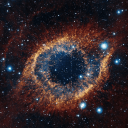
NASA ID: PIA09178
Center: JPL
Secondary Creator Credit: NASA/JPL-Caltech/Univ.of Ariz.
Date Created: 2007-02-12
This infrared image from NASA Spitzer Space Telescope shows the Helix nebula, a cosmic starlet often photographed by amateur astronomers for its vivid colors and eerie resemblance to a giant eye. -
Dark Space
This image is from NASA Galaxy Evolution Explorer is an observation of the large galaxy in Andromeda, Messier 31. The Andromeda galaxy is the most massive in the local group of galaxies that includes our Milky Way. -
Dark Space
This festive NASA Hubble Space Telescope image resembles a holiday wreath made of sparkling lights. The bright southern hemisphere star RS Puppis, at the center of the image, is swaddled in a gossamer cocoon of reflective dust illuminated by the glittering star. The super star is ten times more massive than the Sun and 200 times larger.
RS Puppis rhythmically brightens and dims over a six-week cycle. It is one of the most luminous in the class of so-called Cepheid variable stars. Its average intrinsic brightness is 15,000 times greater than the Sun's luminosity.
The nebula flickers in brightness as pulses of light from the Cepheid propagate outwards. Hubble took a series of photos of light flashes rippling across the nebula in a phenomenon known as a "light echo." Even though light travels through space fast enough to span the gap between Earth and the Moon in a little over a second, the nebula is so large that reflected light can actually be photographed traversing the nebula.
By observing the fluctuation of light in RS Puppis itself, as well as recording the faint reflections of light pulses moving across the nebula, astronomers are able to measure these light echoes and pin down a very accurate distance. The distance to RS Puppis has been narrowed down to 6,500 light-years (with a margin of error of only one percent). -
Dark Space
Hubble Captures Tangled Remnants of a Supernova
This dark, tangled web is a supernova remnant, created after a massive star ended its life in a cataclysmic explosion.